

I am a historian. I am a researcher. I like to find things. It’s fun. It’s a game to play. I have a really high IQ and did fuck all with it.
I have an interesting set of morals. Non-traditional by most standards. But I believe in right and wrong. There are certain things that are just right.
I also believe in law. I believe most laws are there for a reason, and we can change them as we need.
I’m torn in the moment.
There are laws and rules and reasoning that protect people from wrongdoing by their governments. There are constitutional protections, public-records laws, due-process rights, and countless safeguards that exist because history has repeatedly demonstrated what happens when government power goes unchecked.
But also, corporations are fucking evil. Particularly large insurance conglomerates. They have the power, time, money, and resources to truly take on the government in ways that ordinary citizens never can.
So where do my personal morals lie on this?
Do you help the government that dismissed you and left you to die? Do you look at it from that personal stance and refuse to view it through the lens of the greater good? When the government is corrupt and clearly in the wrong, is it not for the greater good to make that known?
And what about benefiting the corporation that would roll over you without a second thought if you ever got in its way? They could give a fuck about me. Why should I help them?
I keep coming back to the same question.
If you possess information that could expose misconduct, unfairness, or potentially improper government action, do you have an obligation to make that information available regardless of who benefits?
That is the part I cannot get past.
The answer cannot depend on whether I personally like the people who might benefit from it. It cannot depend on whether the government involved treated me fairly. It cannot depend on whether the corporation involved would ever do me a favor in return.
Either transparency matters or it doesn’t. Either public records exist to allow citizens to examine the conduct of their government or they do not. If the information is lawfully public, then the question is not who benefits from knowing it. The question is whether the public has a right to know it exists.
What is right is right, right?
If the law says they can, and all I do is hand over the public-record dossier, then it is the law that will make any decisions.
But it is truly one hell of a dossier.
{D} used to say that the only reason Nevada hired him was because they don’t do background checks. I remember that motherfucker in 2022 when Lombardo got elected. He was in a fucking panic that he was going to get fired.
He used to say it all the time.
“If they knew about me, I’d lose my job.”
That is actually the reason I went the route I went when I sent the complaint. It was {D}’s idea.
I downloaded the spreadsheets of every DOI complaint from 2017 through 2024. I’m going to build a database this weekend. These should already be in a database. MS Access much? Fucking govies.
I’ve already pulled Legislative Budget Account 504-3813. Those numbers are about half of what was reported by DOI in a press release, so now I need to see the accounting on this.
Put it all together and see what the potential damage is.
That dossier has to be ethical.
If I am going to do this, it cannot be a hit piece. It cannot be selective. It cannot be built around conclusions and then backfilled with evidence that supports them.
The dossier has to be factual. It has to be sourced. It has to be complete to the greatest extent possible. If there are records that support my position, they belong in it. If there are records that undermine my position, they belong in it too.
If there are gaps in the record, those gaps should be acknowledged. If there are competing explanations, those explanations should be included. If there are facts I cannot prove, they should be identified as allegations, assumptions, or questions rather than presented as established truth.
The moment the dossier stops being an effort to document what happened and becomes an effort to manufacture a particular outcome, it loses its legitimacy.
The purpose is not to tell people what to think. The purpose is to place the available facts in front of them and allow them to reach their own conclusions.
If the facts are strong enough, they do not need my help.
My dad always asks me why I always burn bridges.
I always say, “Why’d the motherfuckers gotta hand me the matches?”
This would in no way, shape, or form be financially beneficial to me. I wouldn’t get a dime. I would simply know that the thing they left me to die to avoid happened anyway.
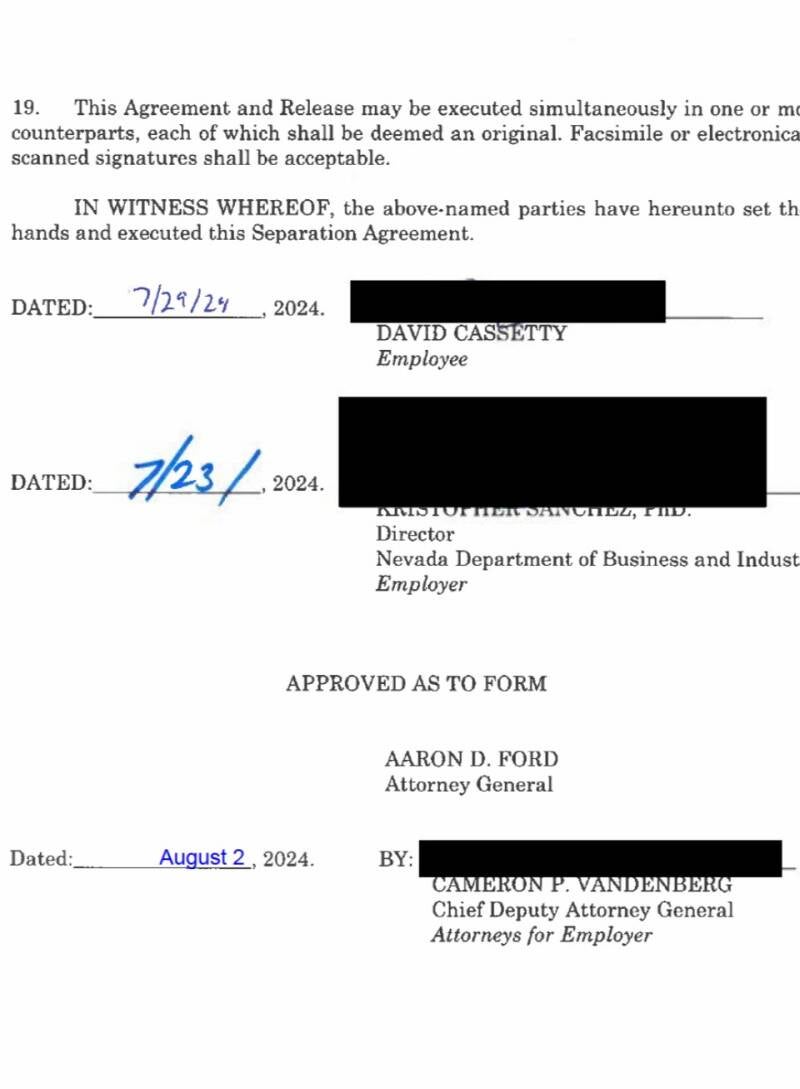
And they signed a non-disparagement agreement on the motherfucker.
With Aaron Ford’s authority.
I don’t know how much of it would actually get reversed, but goddamn, it would be a fucking shitshow for them. I mean, we are talking seven years of investigations and penalties and fraud cases and the whole bail-bond reform.
There is no clawback clause in Nevada law for that Administrative Synopsis, and I have a First Amendment right to publish and disseminate that document as a private citizen.
Everything from Vermont is databased.
It is in no way illegal for me to point entities to that database and allow them to do their own research. All of it is public record. I’m just pointing it out and connecting a couple dots.
No opinion on my part. No push. No narrative.
Just: here is a dossier. Thought you might be interested.
And then just see what happens.
So is this right or wrong? Is it good or evil?
It’s truly maniacal. That one is one hundred percent true.
What I know is that the state ignored me. They dismissed me. They were told the toll they were taking on me, and they refused to speak to me anyway. What I know is that I was told he was being arrested. Then suddenly he wasn’t, and it became a jurisdictional issue. What I know is that the director knew about the arrest beforehand, and that the meeting they took him into had been pushed back.
Whose fucking jurisdiction were we even talking about?
What I know is that I’m legally in the right. And even if I wasn’t, I don’t believe I would necessarily care. You can’t unfuck the Thanksgiving turkey.
But legality is not really the question. The question is whether I have an obligation to sit on information that may reveal misconduct, unfairness, or failures by people entrusted with public power. The question is whether public records exist to be examined or merely archived and forgotten.
{D} once explained to me how you place a value on a human life. I feel a little better knowing we’re talking about tens of millions of dollars, because, man, I was feeling pretty worthless.
The State of Nevada left me to die. And if I hadn’t sent those emails to the women who worked for him, I believe they would have done nothing.
Maybe I’m wrong. Maybe there are facts I still don’t know. Maybe there are explanations that have never been provided. That is why the dossier has to be complete. That is why it has to be factual. That is why every source has to be cited and every conclusion has to be supported. If I am going to put something into the world, it has to be strong enough to stand on its own without my anger holding it up.
At the end of the day, I won’t be the one making any decisions. I won’t be issuing fines. I won’t be overturning investigations. I won’t be filing lawsuits. I won’t be rendering judgments.
I’ll simply be handing people information and trusting them to decide what it means.
If that information changes nothing, then nothing changes.
But if the truth is capable of causing damage all by itself, then maybe the damage was already there long before I arrived with a flashlight.
Fuck. Imma have to leave the state.

Add comment
Comments